
August 1, 2003
By Samuel R. Kwon, Roy S. Belden and Tamara Stevenson
Renewable energy credits, or RECs, are becoming an additional source of financing for windpower, biomass and other renewable energy projects. However, a proceeding before the Federal Energy Regulatory Commission could award such credits to the utilities that buy the output rather than the generators that own the projects.
RECs and RPS
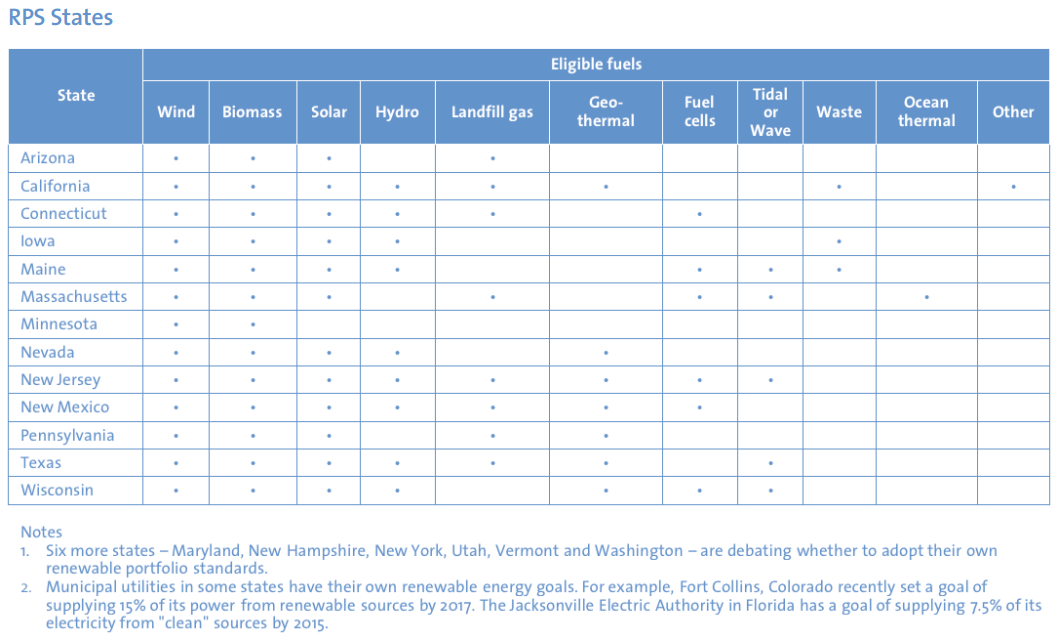
RECs are credits at the state level for using renewable fuels, like wind, biomass or sunlight, to generate electricity. To date, 13 states have adopted some form of “renewable portfolio standard,” or law requiring utilities in the state to ensure that a certain percentage of their electricity comes from renewable sources. Five other states have adopted voluntary goals to increase the use of renewable fuels. At least another five states are considering adopting RPS-type legislation. (See the table of RPS states below). Once a state adopts an RPS, then utilities in the state that do not meet the requirements of the RPS are assessed penalties.
Currently, there is no separate federal renewable portfolio standard (although Congress is considering whether to adopt one as part of the energy bill), and RPS requirements in the 13 states vary from state to state. For instance, Arizona’s RPS applies to all utilities and rural electric cooperatives. The Connecticut RPS applies to utilities, but a utility does not count as part of its electricity output electricity that it purchases from wholesale suppliers under a “standard offer.”
The percentages of electricity that must come from renewable sources also vary from state to state and over time. For example, Arizona requires utilities only to generate 1% of electricity from renewable fuels by 2005 and 1.1% by 2007. Texas requires that there be statewide at least 1,280 megawatts from renewable fuels by 2003, 1,730 megawatts by 2005, 2,280 megawatts by 2007 and 2,880 megawatts by 2009.
What qualifies as a renewable fuel also varies from state to state. In all states, wind and biomass qualify. Most states also accept some form of solar energy. However, only some states allow landfill gas, fuel cells, waste, geothermal energy, wave, hydroelectric and tidal energy.
Issues With RECs
A utility can meet its obligation under a state RPS by generating the electricity itself or by purchasing power from a third party. Alternatively, the utility can simply buy renewable energy credits from a third party.
A utility hoping to satisfy its RPS obligations using purchased RECs faces at least three issues. The first issue is whether the state’s RPS allows the utility to use RECs in the first place to satisfy its RPS obligations by permitting renewable generators to transfer RECs. Not all states with RPS or AUGUST 2003 PROJECT FINANCE NEWSWIRE 29 Cv bnm RPS States 30 PROJECT FINANCE NEWSWIRE AUGUST 2003 similar programs allow the transfer of RECs for such purposes. For example, Connecticut, Massachusetts, Nevada, Texas and Wisconsin currently allow renewable generators to sell their RECs as long as the transaction is reported to the entity administering the RPS. New Jersey and Iowa do not.
The second issue is whether a utility in one state can use RECs from another state. For example, utilities in Connecticut, Maine and Massachusetts — the three states in the New England Power Pool, or NEPOOL, that have renewable portfolio standards — can use RECs from other states in the power pool (or adjacent power pools whose power flows into NEPOOL). Wisconsin does not allow out-ofstate RECs to be used by in-state utilities to satisfy its renewable portfolio standard.
The third issue in using RECs is to make sure RECs are used before they expire. For instance, in Texas, RECs not used for compliance within three years will be “retired” for compliance purposes, and cannot be used by the utility that held them.
Trading in RECs
In some states, RECs are trading in auction-like markets. There are two established markets for secondary trading.
One is in Texas. The Texas RPS obligates all retail suppliers of electricity to hold RECs based on the level of their annual retail electric sales in the state. The Electric Reliability Council of Texas, or ERCOT, measures the amount of the retail sales of the suppliers. ERCOT also administers the trading program, allocating RECs to generators that use renewable fuels. The utilities must obtain enough RECs either by generating the electricity themselves or by purchasing RECs on the open market.
RECs in Texas are easily transferred through a web-based platform managed by ERCOT; negotiation of the price and other sales terms is done privately. REC prices in 2002 fluctuated widely from $4.25 per mWh to $16.75 per mWh of power. In 2003, the average bid price for RECs was $11 per mWh, and the average ask price was $12.25 per mWh.
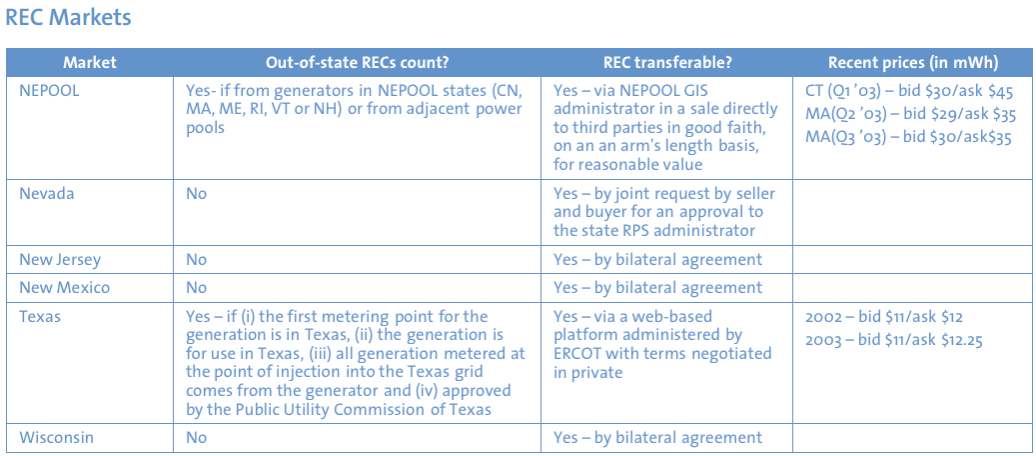
The other established market for trading RECs is NEPOOL. Of the six NEPOOL participants, three states have adopted a form of RPS — Connecticut, Maine, and Massachusetts — while three states have not — New Hampshire, Rhode Island and Vermont. The versions of RPS adopted by Connecticut, Maine and Massachusetts all allow utilities in each state to satisfy their RPS obligations by procuring RECs from generators within the NEPOOL territory, including from generators in the states that have not adopted an RPS. They also allow the use of RECs from generators in any adjacent power pool as long as the power from RECs continued from page 29 REC Markets that power pool flows into NEPOOL.
The trading of RECs is handled by NEPOOL’s generation information system, a market-priced bid-based power exchange system similar to the one maintained by ERCOT in Texas. The REC trading prices in NEPOOL vary. For instance, the average ask price for RECs from Massachusetts-based generators in the second quarter of 2003 was $35 per mWh while the bid price was $29. The ask price by Connecticutbased generators for the first quarter of 2003 was $45 per mWh, and the bid price was $30 per mWh. The NEPOOL states with RPS standards have idiosyncratic rules on what qualifies as an acceptable REC. For example, Massachusetts requires RECs to be from “new” facilities that began producing electricity after December 31, 1997.
An alternative to obtaining RECs from a trading market is to arrange for their purchase from an independent generator directly. Private sales take place among utilities and holders of RECs in states that allow transfers of RECs, but do not yet have active exchanges for trading. Such states include Nevada, Wisconsin and New Mexico. New Jersey is considering whether explicitly to allow trading. Utilities that offer “green power” to end users of electricity at a premium also purchase RECs through private transactions at times even though the states in which they operate do not impose any RPS obligations on them. An example might be a utility in Rhode Island that buys RECs through NEPOOL. However, the participation rates in half of these “green power” programs offered by some 1,240 electric utilities nationwide have been less than 1%.
Ownership of RECs
The question whether a power sales contract conveys to the buyer of electricity not only the energy and capacity but also the corresponding RECs has arisen recently in two state-level proceedings and a proceeding before the Federal Energy Regulatory Commission. All three proceedings involve qualifying facilities, or QFs, under the Public Utility Regulatory Policies Act, or PURPA, that entered into longterm power sales contracts with utilities for the sale of their output. The contracts were signed before there was such a thing as a REC.
In one state proceeding, the Maine Public Utilities Commission concluded in September 2002 that the utilities — rather than the QFs — have the rights to RECs being traded on NEPOOL under the PURPA contracts because the utilities’ purchases of QF power include purchases of associated RECs. The decision is being appealed. In another state proceeding, the Connecticut Department of Public Utility Control is examining whether the Connecticut Light & Power Company is entitled to the RECs that a QF receives from NEPOOL because RECs are an inseparable part of the entire electric output that the QF is required to deliver to the utility.
In a separate proceeding before FERC, four unrelated owners of QFs have petitioned the agency for a declaratory order that PURPA contracts do not convey RECs to the purchasing utility. These QF owners argue that the “avoided cost” that utilities pay to QFs under PURPA contracts compensates QFs only for the energy and capacity produced by the QFs and not for any environmental attributes associated with the QFs, including the RECs. FERC is currently considering the matter.
Related Environmental Credits
Apart from RECs, the volume of trading of other “environmental credits” both in the US and abroad is gradually increasing. The US has long recognized emission credit trading programs as a mechanism for achieving emission reductions in sulfur dioxide and nitrogen oxides. These programs are largely driven by mandated emission-reduction requirements.
Greenhouse gas credits are another environmental credit mechanism that is also in its infancy. The market for greenhouse gas credits is expected to grow stronger when the Kyoto protocol is implemented in the European Union countries, Canada and Japan. The protocol will take effect once one more large country ratifies it. Russia is expected to do so later this year or early next year.
The Kyoto protocol is a commitment by the international community of nations that has ratified the treaty to reduce greenhouse gases over time. Once it takes effect, the signatory countries become obligated to reduce their emissions. Greenhouse gases are carbon dioxide, methane, nitrous oxide, hydrofluorocarbons, perfluorocarbons and sulfur hexafluoride, all measured in “CO2 equivalents.” The Kyoto protocol leaves it up to each country to reduce its greenhouse gas emissions without specifying how. The member countries of the European Union are spearheading the implementation effort.
The European Union directive on greenhouse gases is expected to establish a “cap-and-trade system.” Under this system, the government in each member country would give out at least 95% of credits to emit greenhouse gases to companies in its country as it sees fit. The remaining credits are likely to be auctioned off. The United Kingdom has its own emissions trading scheme, and it may opt out of the EU program at least during the pilot phase of the EU program from 2005 to 2007. Point Carbon, a Norwegian-based research group, estimates that the EU emissions market could grow from $1.15 billion in 2005 to $8.51 billion in 2007.
The US government has rejected participation in the Kyoto protocol. As a result, an active market for trading of greenhouse gas credits in the US does not exist currently. However, trading on the Chicago Climate Exchange, an electronic exchange for trading various greenhouse gas credits among companies that voluntarily choose to reduce their greenhouse gas emissions, is scheduled to begin on October 1, 2003. Some experts are skeptical whether there will be much trading without a legal requirement for US companies to reduce emissions. To date, 14 companies and the city of Chicago have signed up to participate.
Movement to Disallow Dual Benefits
A generator using renewables to produce electricity in a state with an RPS accumulates RECs for its own use or sale to third parties. If the use of the renewables also happens to reduce greenhouse gases — for example, the generator operates a power plant using landfill gas as the renewable fuel — the generator may be able to “sell” the reduction in greenhouse gases to third parties. While there are currently no mandatory emission reduction requirements for greenhouse gases, some industrial companies purchase greenhouse gas credits to boost their reputations as environmentally-friendly companies while others might purchase the credits in anticipation of future regulations that will require reductions in greenhouse gases. A generator could theoretically end up selling the same environmental benefits twice — once in the form of RECs and once as a greenhouse gas credit.
Currently, the various forms of state RPS generally lack explicit statutory or regulatory mechanisms to curb the double counting of benefits from a single use of renewables. There are several third-party organizations that certify RECs. Most of these organizations, such as Green-e, have policies in place to prevent certification of the environmental attributes of using renewable fuel as an REC if, at the same time, the generator has also received other emission reduction credits for the same attributes or the generator is required by law to use the fuel to comply with emission reduction requirements.
Financing Possibilities
To what extent RECs and other environmental credits will become steady sources of financing for renewable energy projects depends in part on how rapidly the volume of trading in the credits increases in the future. Evolution Markets, a consulting firm specializing in environmental credits, reported that it has been involved in 50 REC trades to date in 2003. Because the REC trading market is still immature, it has been difficult to establish forward price curves that are important for developers of power projects wishing to obtain financing using RECs. There are about a dozen companies currently active in the market for RECs, according to recent published reports.
RECs and other environmental credits will probably never be valuable enough to finance the entire cost of a renewable energy project. However, as the markets in these credits deepen and prices stabilize, they should become a source of additional funds. A company may issue different tranches of debt, one of which is backed by RECs or other environmental credits. Alternatively, debt service reserves may be funded by cash expected from sales of such credits, or even insurance premiums or hedging costs may be funded in part by such credits.
Possible Federal RPS
The Senate passed an energy bill at the end of July that would impose a national renewable portfolio standard. Beginning in 2005, each retail electric supplier would have to obtain at least 1% of its electricity from renewable sources. The percentage would increase to 10% by 2020. Generators using renewable fuels would be awarded credits by the US government. A utility would have to turn in credits at the end of each year equivalent to the required percentage — for example, 1% — of its retail “base” load. It could obtain the credits either by generating renewable electricity itself or by purchasing credits from independent generators. RECs continued from page 31 The House version of the energy bill does not include a renewable portfolio standard. The House passed its version last April.
The measure goes next to a House-Senate “conference committee” where senior members from both houses will to try to write a common bill to send to the president. The renewable portfolio standard is only one of many differences with which the conferees will have to grapple. They gave up on the energy bill last year after being unable to reach agreement.